
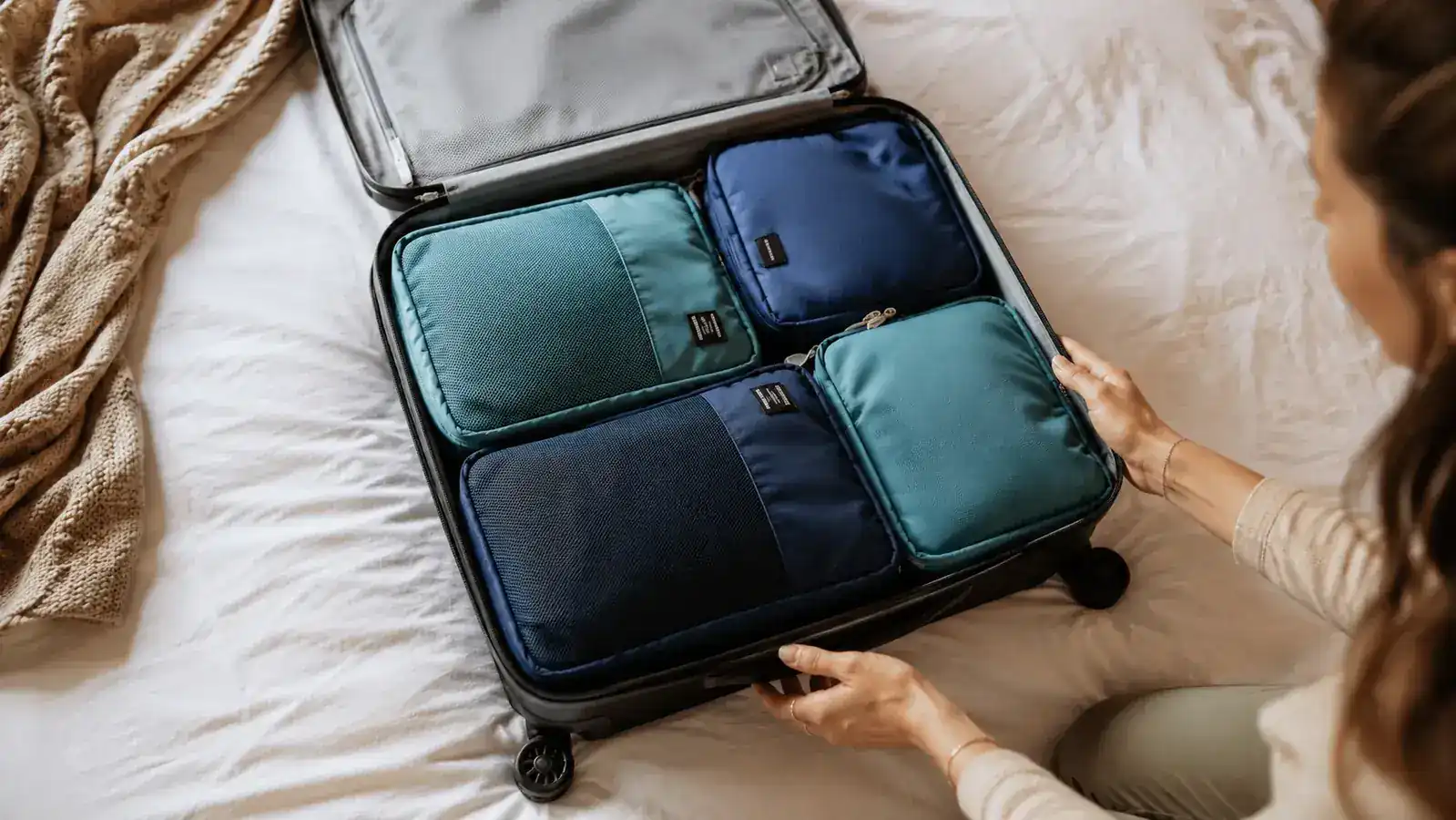
Here is what nobody tells you before your first big trip: the checked-bag fee is not the real tax. The real tax is the forty-five minutes you spend at baggage claim, staring at a carousel, while everyone who packed smarter is already in a cab. I know because I paid that tax for years. Then I figured out how to fit a full week of clothes into a single carry-on, and I have not checked a bag since 2019.
The thing that made it actually work was compression packing cubes, specifically the BAGAIL 8-set. Not because they magically create space, but because they force you to pre-commit to what goes in the bag, and then they compress it down to a fraction of its loose volume. This guide walks through the exact five-step system I use before every trip. Follow all five steps, and a week of real clothes (not just resort-weekend clothes) fits into a standard 22-inch carry-on with room to spare.
If your last trip cost you in bag fees, this is the fix
The BAGAIL compression packing cubes are what make carry-on-only packing reliable for a full week. Four sizes in one set, double zippers, machine-washable mesh. Check current pricing before you book your next flight.
Amazon Check Today's Price on Amazon →Step 1: Build Your Packing List Before You Touch the Bag
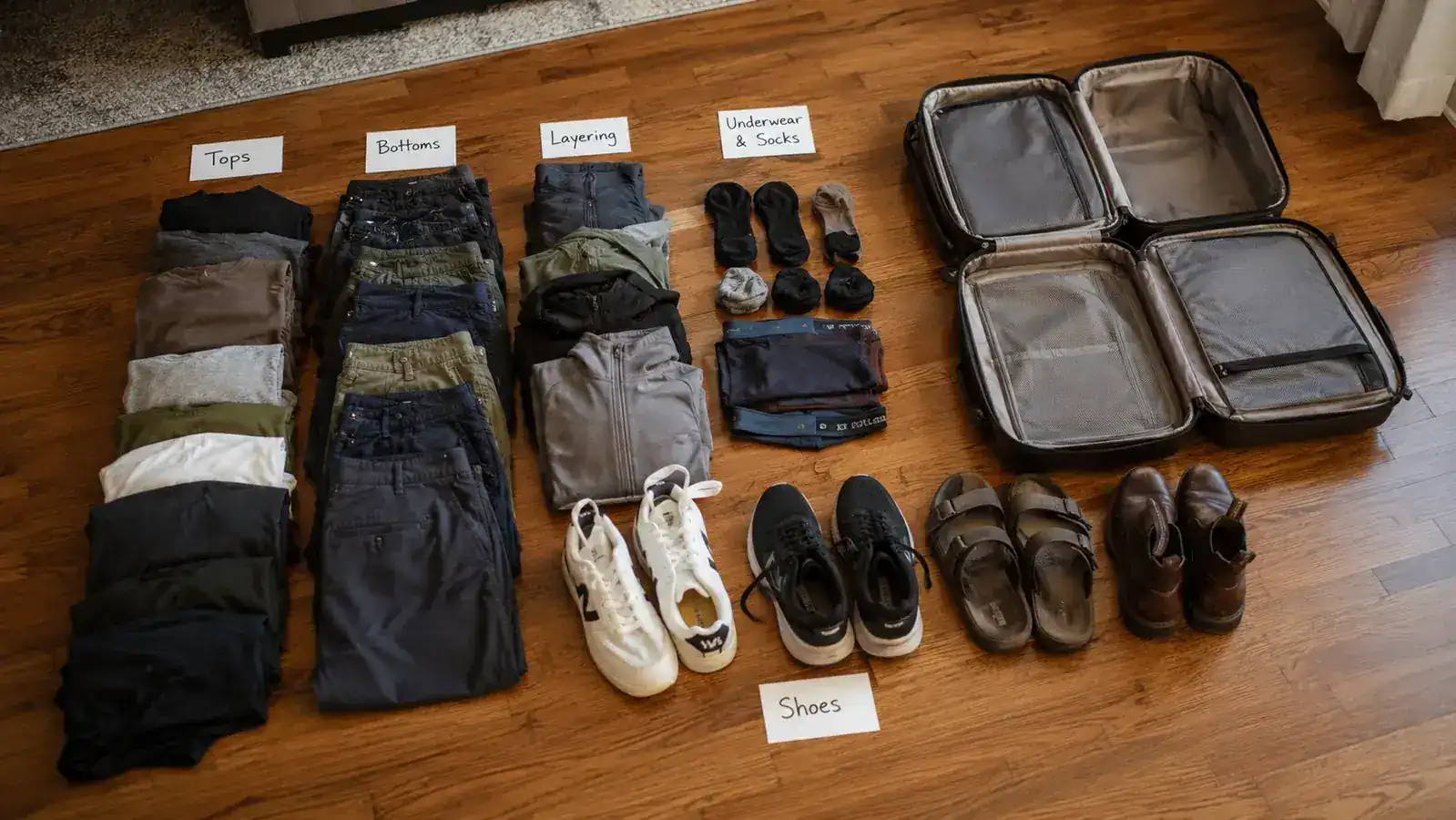
The mistake most people make is opening the suitcase first and then deciding what to pack. That approach fills the bag with whatever is nearby, not whatever is most useful. Instead, sit down with a notepad (or the Notes app) the night before you pack and write out every category: tops, bottoms, a layering piece, shoes, underwear, socks, toiletries, and electronics. Then assign a specific number to each.
My standard seven-day list looks like this: five tops (three t-shirts, one button-down that doubles as a light layer, one nicer shirt for dinners out), two bottoms (one versatile trouser, one dark jean that reads casual or smart depending on the shoes), one lightweight merino cardigan, seven sets of underwear and socks, one pair of walking shoes worn on the plane, one pair of sandals packed flat. That is it. The rule I use: if I cannot imagine wearing something at least three times on a seven-day trip, it does not make the list.
Write the list before you open the suitcase. Commit to it. The rest of the system only works if the list is done first.
Step 2: Sort Into Cube Groups, Not Just Categories
The BAGAIL set comes with two large cubes, two medium cubes, two small cubes, and two slim cubes. The slim ones are designed for flat things like scarves or a swimsuit. For a seven-day trip, I use four cubes and leave the rest in the drawer at home. Bringing all eight for a week-long carry-on trip is overkill and wastes compression.
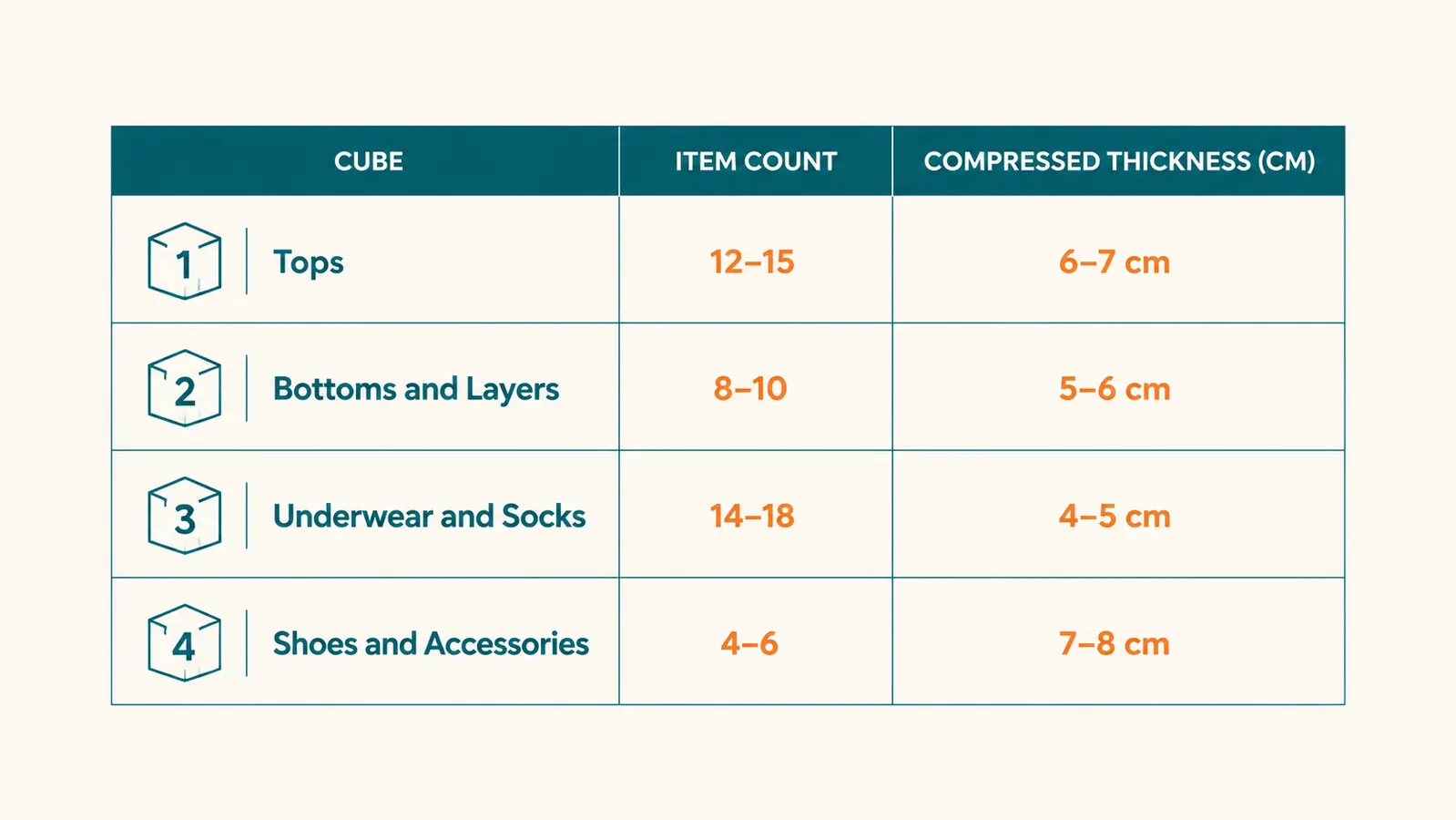
Cube 1 (large): all tops. Cube 2 (large): bottoms and the cardigan rolled tight. Cube 3 (medium): underwear and socks. Cube 4 (small): sandals wrapped in a reusable bag, plus any flat accessories like a belt or a sleep mask. Toiletries go in a separate hanging toiletry bag, not a cube. Electronics go in the personal item, not the carry-on. This sorting step matters because it tells you exactly where everything is when you need it at 11pm in a hotel room.
Step 3: Fold and Load Each Cube the Right Way
The ranger roll (military-style tight roll) compresses clothes better than the standard fold before they even go into the cube. For t-shirts, fold in thirds lengthwise, then roll from the bottom up as tightly as you can. For trousers, fold in half along the seam, then roll from the cuff up. The roll keeps creases minimal and makes clothes stack vertically inside the cube, which is how you fit five t-shirts into a large BAGAIL cube without them sliding around.
Stand each roll upright in the cube rather than laying them flat. Think of it like filing folders, not stacking books. When everything stands vertically you can see every item at a glance, and grabbing one shirt does not disturb the others. Fill the cube to slightly over-full before you close the main zipper. It should feel a little resistant. That resistance is what the compression zipper is designed to handle.
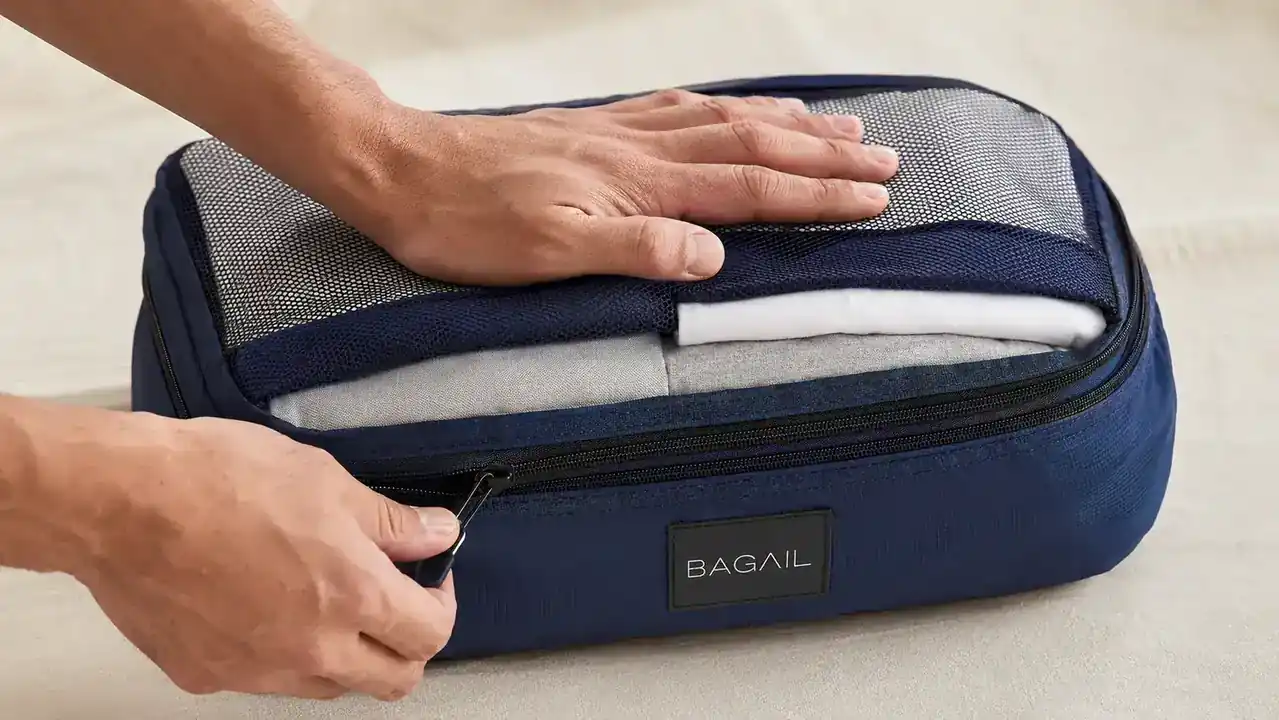
Once the main zipper is closed, run the compression zipper around the perimeter. On the BAGAIL cubes, this is the second zipper track that goes all the way around the edge of the cube. As you close it, you will feel the cube flatten down by a noticeable amount. For a fully loaded large cube packed with five rolled t-shirts, the compression zipper typically reduces the height from about 4.5 inches to under 3 inches. That centimeter-by-centimeter difference is what makes a full week of tops fit without overflow.
Step 4: Load the Carry-On in the Right Order
How you arrange the cubes inside the suitcase matters more than most people expect. The goal is two things: a low center of gravity so the bag wheels straight, and a layout that puts the things you need during the trip on top.
Put the heaviest cube, usually Cube 2 with bottoms, flat against the back panel (the wheel side). Place Cube 1 with tops on top of or beside it. The medium cube with underwear and socks goes on top, where it is easy to grab each morning. The small cube with shoes and accessories goes in whatever gap remains, usually at the foot of the bag or compressed into a corner. If your carry-on has a dedicated shoe pocket or a front zipper compartment, use that for the sandals instead.
Toiletries go in the outside zipper pocket if your bag has one, or tucked on top of the cubes if not. The outside pocket is preferable because you can grab the toiletry bag for a TSA tray without opening the main compartment. After loading, grab the bag by the handle and lift it. If it feels stable and does not tilt, the weight distribution is right. If it tips forward, shift the heaviest cube toward the bottom.
The compression zipper reduces a fully-loaded cube from 4.5 inches to under 3. That is the difference between a bag that zips and one that does not.
Step 5: Do a Dress Rehearsal the Night Before, Not the Morning Of
The single biggest mistake carry-on packers make is leaving the actual packing for the morning of the flight. You think you have thirty minutes. You have fifteen. In those fifteen minutes you make panic additions (a second pair of shoes, a backup jacket, that book you probably will not read) and suddenly the bag does not zip.
Pack the cubes the night before. Close the carry-on. Put it by the door. That gives you an eight-hour buffer to think of anything you genuinely forgot, and it removes the temptation to add things at 5am when your judgment is compromised. I take a photo of the open bag before I close it, so if I need to find something specific at the hotel I can refer back to the layout without unpacking everything.
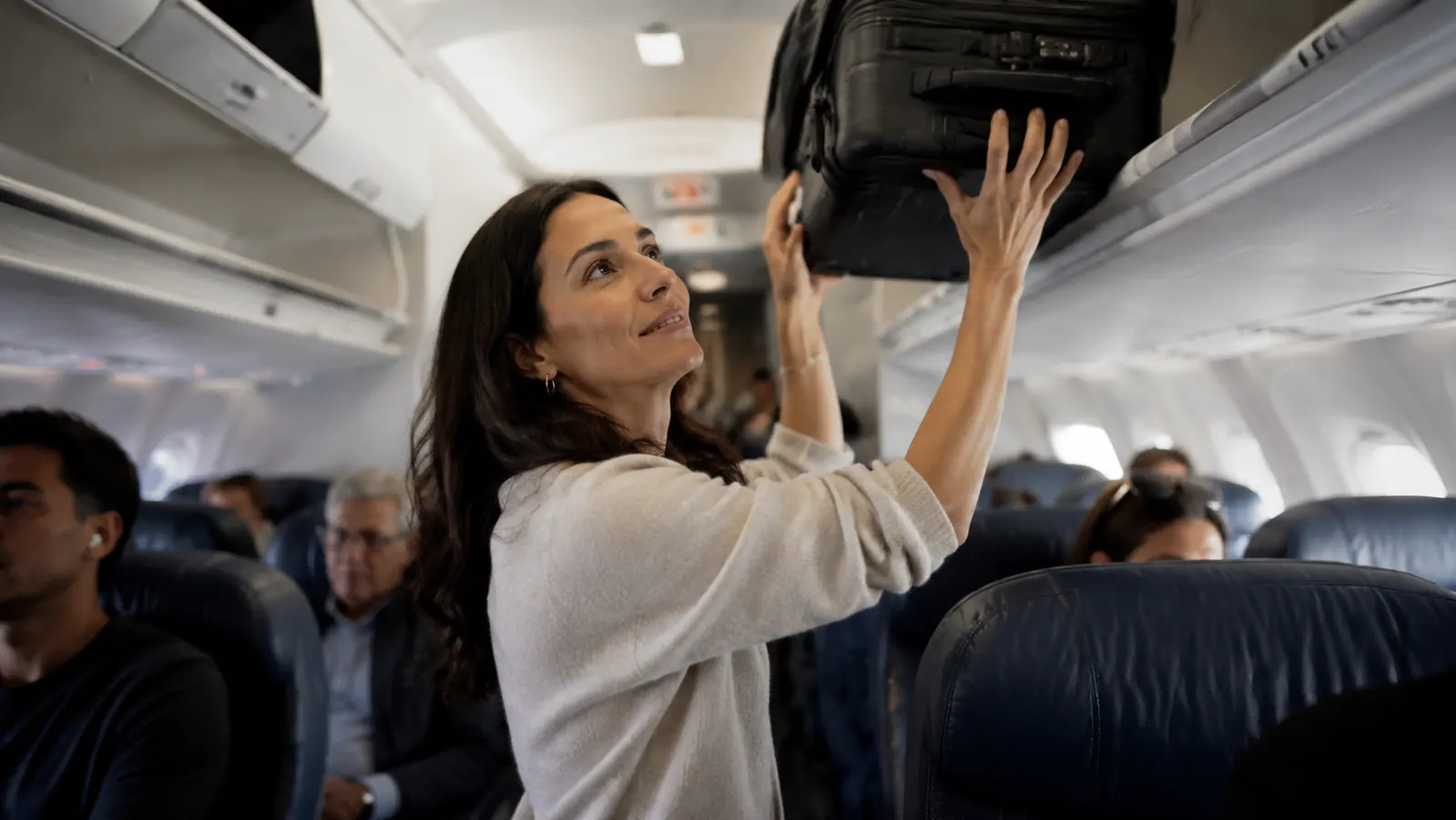
One more thing: weigh the bag. Most airlines allow a carry-on up to 22 pounds (some budget carriers go lower, so check your specific airline). A packed 22-inch carry-on with four BAGAIL cubes and a week of clothes typically lands between 17 and 20 pounds, which gives you room to add a laptop in the main compartment if you prefer to keep it there instead of in a personal item. Knowing the weight before you leave the house removes the last source of carry-on anxiety.
What Else Helps
The compression cubes do the main work, but a few companion habits make the whole system more reliable. Wearing your bulkiest items on the plane is the oldest trick in the book and still the best one. If your heaviest shoes and thickest jacket are on your body, they are not fighting for cube space. I fly in my walking shoes and the cardigan or jacket every time, even if I land somewhere warm. On the plane I stuff the cardigan in the seat pocket.
Packing neutral colors that mix and match is the other lever. Five tops in navy, white, grey, and olive go together in every combination. Five tops in unrelated patterns do not. The mixing-and-matching principle is what lets you wear five tops across seven days without feeling like you are repeating outfits. It sounds obvious, but it is the first thing that falls apart when you pack in a rush and grab whatever is clean.
If you travel with a partner, coordinate cube colors before you both pack. The BAGAIL set comes in multiple color options. Choosing different colorways for each person means you can share overhead bin space without spending five minutes sorting whose cube is whose at the hotel. Small thing, but it matters at midnight after a long-haul flight.
Common Questions
Will compression cubes work in a soft-sided bag? Yes, and in some ways better, because a soft carry-on has more flex than a hard shell. The cubes hold their shape regardless of what surrounds them, and the compression keeps the cube rigid so it does not collapse when you pull it out.
What about the return trip when you have souvenirs or dirty laundry that takes more space? The BAGAIL compression cubes work in both directions. On the return, I put clean unused clothes in a compressed cube, and loose dirty clothes in a second cube with minimal compression, just the main zipper closed. Souvenirs go into any remaining gap. The point is that the cubes contain the chaos even when things are less tidy.
Are the BAGAIL cubes really machine washable? Yes. I throw them in a cold gentle cycle every few months. The zippers are YKK-style quality and hold up without snagging. Just zip them closed before washing so the teeth stay aligned.
Ready to stop checking bags? The BAGAIL set is the place to start.
The BAGAIL 8-set gives you every size you will ever need, compression zippers on all cubes, and enough mesh panels to see what is inside without opening anything. If one set is all you want to try, the 4-set version covers a week-long trip with the four cubes described in this guide. Check today's price and see which set fits your bag size.
Amazon Check Today's Price on Amazon →Related reading: BAGAIL Compression Packing Cubes Review: 6 Months of Carry-On-Only Travel and 10 Reasons Compression Packing Cubes Are Worth Every Penny.