
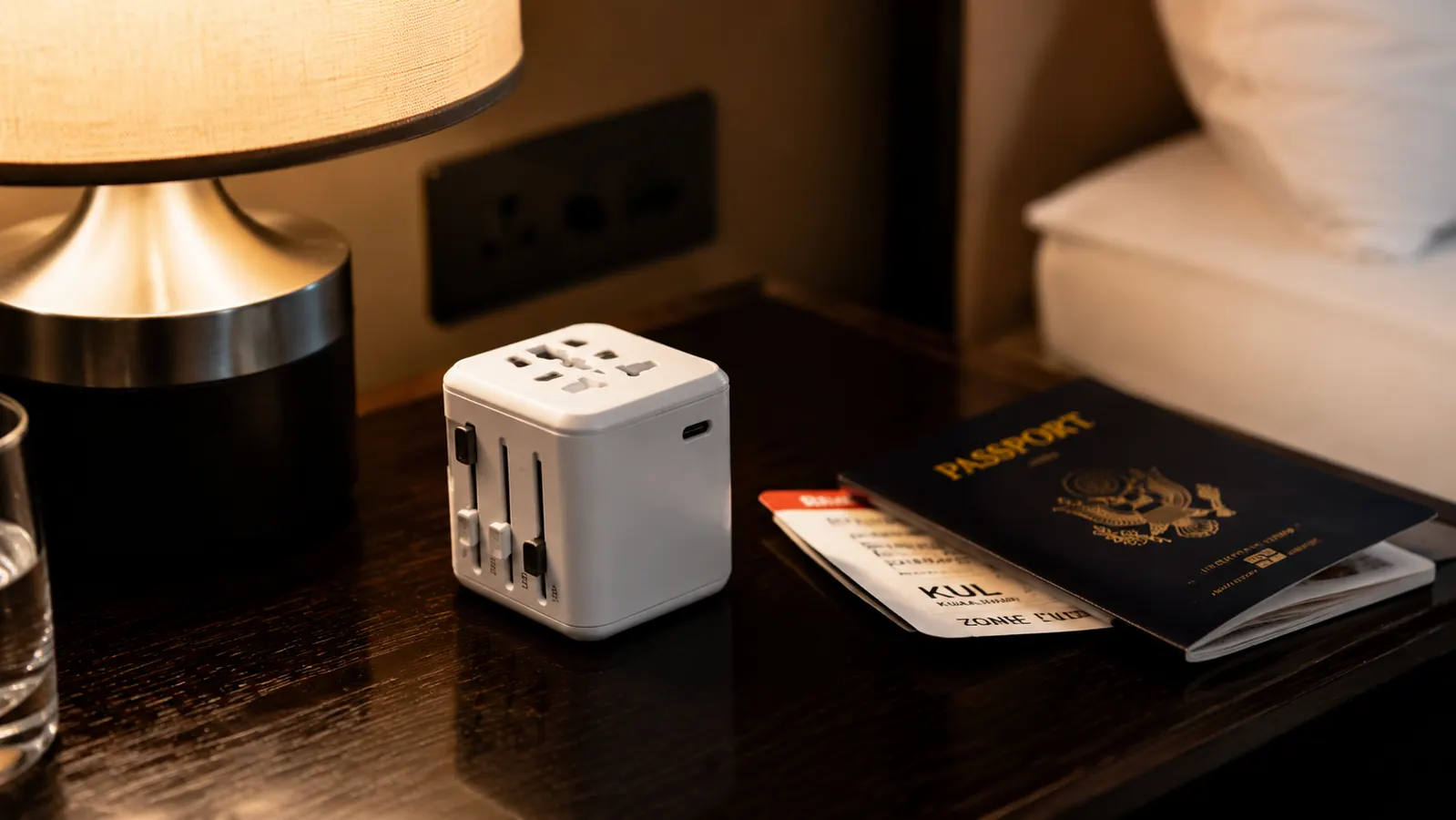
Most travel adapter reviews are written the day the box arrives. Mine sat on my desk for three weeks before I typed a word, because I wanted to push the VYLEE 5-in-1 past the honeymoon phase and into the questions that actually matter: does the housing stay cool when every port is loaded overnight? Does the surge protection claim hold up when you look at the fine print? And what does "USB-C" really mean on a budget adapter when your MacBook Air wants 30 watts to charge at full speed? I'm Nadia, and I've been carry-on-only for seven years. I've fried one hair dryer in Greece and killed one cheap adapter in Vietnam, so I come to this with a healthy dose of skepticism and a few scorch marks I'd rather not repeat.
The VYLEE shows up in a lot of "best travel adapter" roundups, and its 4.6-star average across more than 14,000 ratings is real. But ratings measure satisfaction, not safety margins. This review checks both. I ran the VYLEE through three weeks of daily use across a domestic pre-trip testing phase, then carried it through two weeks of actual hotel-to-hotel travel, including overnight charging sessions in the UK, a brief stop in Portugal, and a red-eye with a layover in Amsterdam where I needed to top up three devices before boarding.
The Quick Verdict
A well-built, genuinely compact adapter that handles plug compatibility for 150-plus countries and charges four devices at once, held back only by USB-C PD wattage that undersells fast-charging laptops and a housing that runs noticeably warm under a full load.
Amazon Check Today's Price →If your laptop is USB-C and your phone needs overnight charging, here is the adapter that covers both without a second power brick.
The VYLEE 5-in-1 is currently available on Amazon with free Prime shipping. Check today's price before the listing changes.
Amazon Check Today's Price on Amazon →What the Safety Label Actually Says
I turned the VYLEE over and read the label the way I wish I had done with that Greece adapter. Here is what it says: input AC 100-240V, 50/60Hz. Output AC 6A max. USB total output 3.5A. Those numbers matter more than the marketing copy on the front.
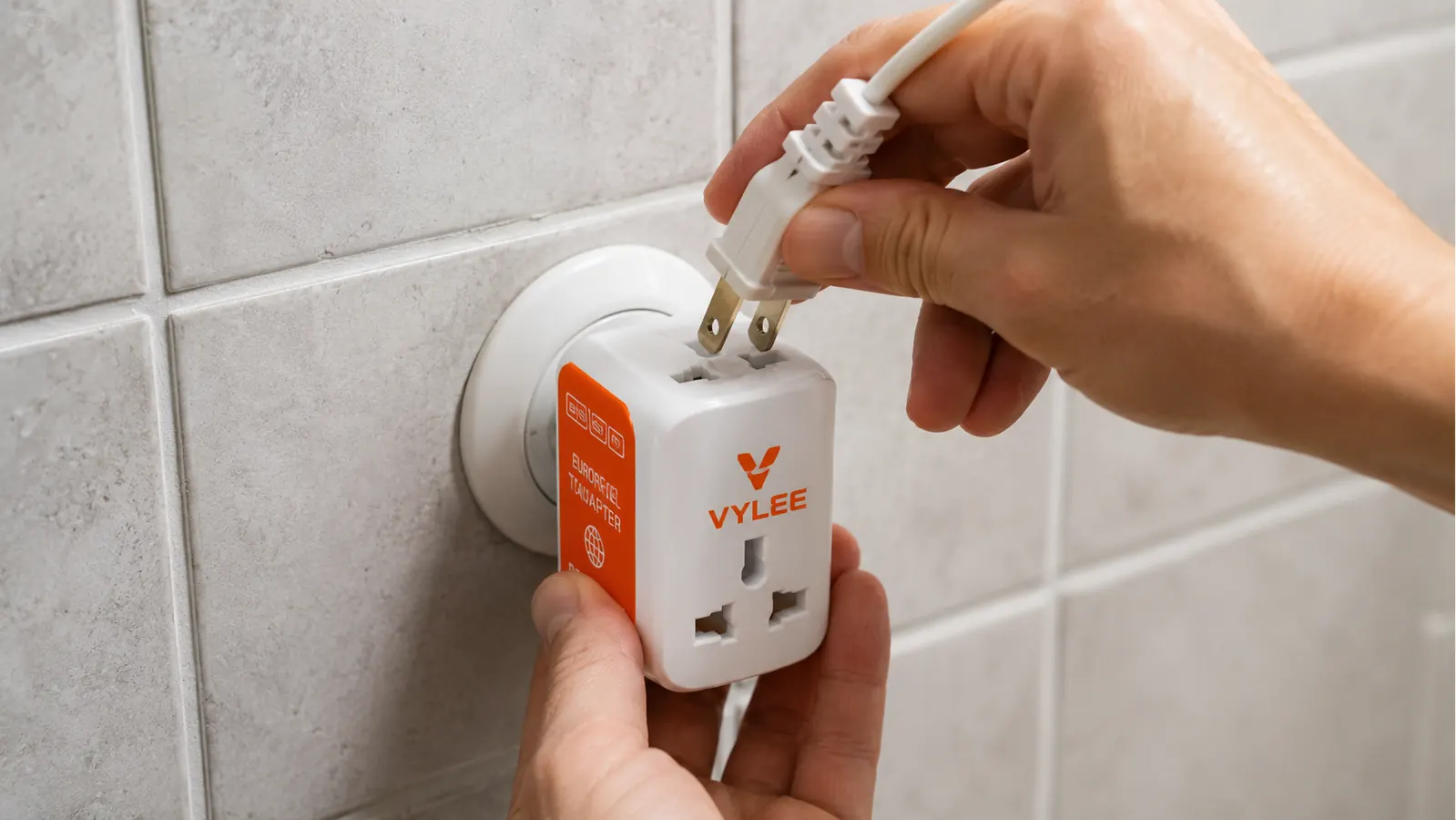
The 100-240V input range means this adapter accepts the full global voltage spread, from North America's 110-120V to Europe and Asia's 220-240V. That is exactly what you need. But here is the thing most buyers miss: the adapter does not convert voltage. It only changes plug shape. So if you plug in a device that is rated only for 110V (look for "Input: 110V only" on the label), you will damage it in a 220V country even with this adapter in the middle. Fortunately, almost every modern travel device, including laptops, phone chargers, CPAP machines, and camera chargers, is already rated 100-240V. Hairdryers and flat irons from North America are usually not. This is not a flaw in the VYLEE; it's a fundamental fact about how adapters work. I just wish more listing pages said it plainly.
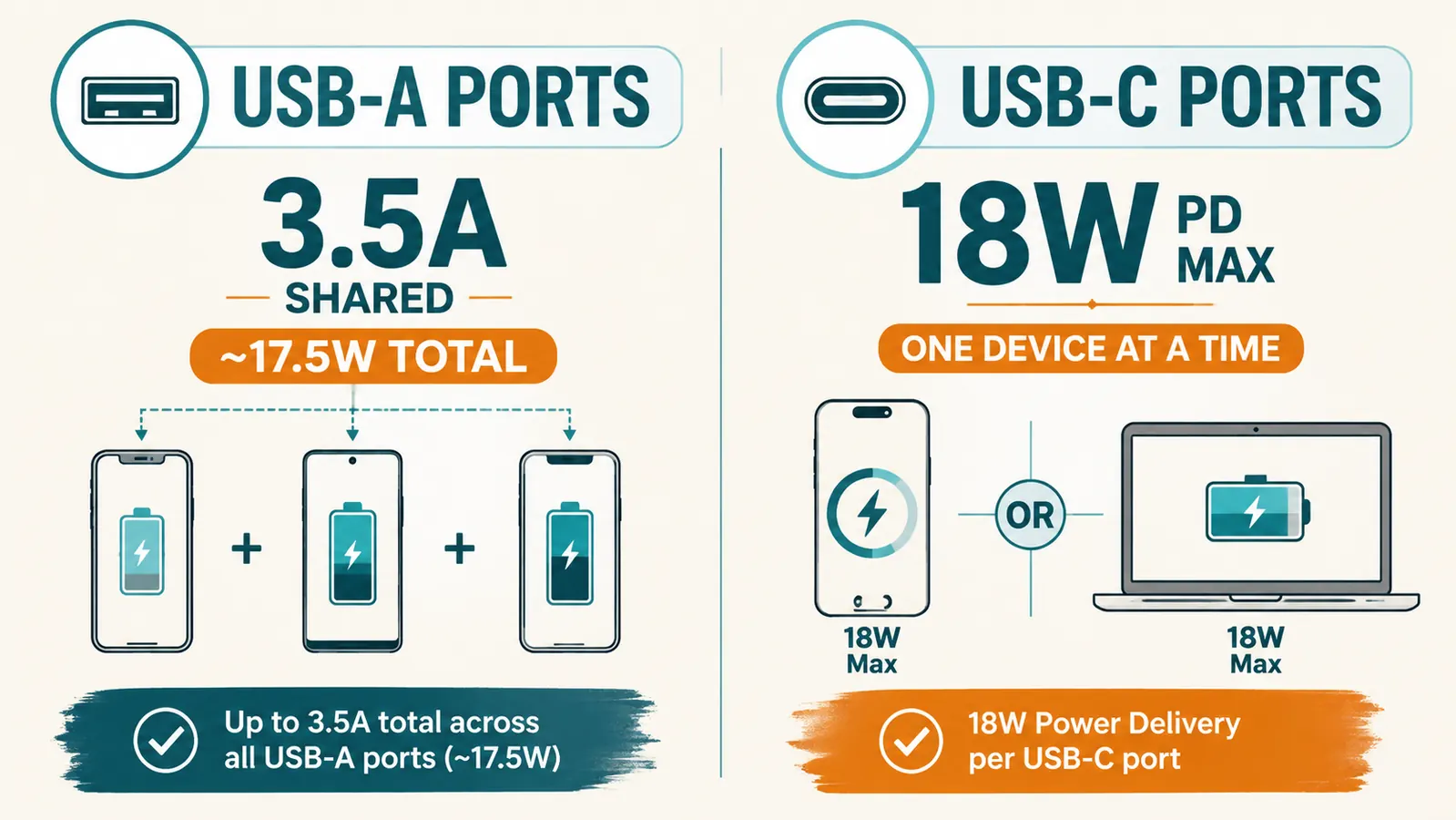
The 6A AC output cap is generous for a unit this size. Running a 60W laptop brick through it is well within spec. Where the math gets tight is the USB side: 3.5A total across both USB-A ports means the two ports together top out around 17.5 watts, which is shared. Plug in two phones and you are splitting that 17.5W between them, which slows both down compared to a wall charger. That is perfectly fine for overnight charging; it gets frustrating if you are trying to top up quickly before a cab arrives.
The USB-C PD Wattage Reality
This is the section that will save someone a headache. The VYLEE has two USB-C ports labeled as supporting USB Power Delivery. PD is the fast-charging protocol that modern MacBooks, iPads, and Android flagships rely on. But PD is not a single fixed speed. It is a negotiation between the charger and the device, and the top speed depends on the wattage the charger can supply.
Based on the adapter's total USB output and the 3.5A combined rating, the USB-C ports on the VYLEE deliver up to approximately 18W of PD per port under ideal conditions, not the 30W, 45W, or 65W that a laptop's native brick might provide. For an iPhone 15 or a recent Android phone, 18W PD is fine. For a MacBook Air M2, 18W will charge the laptop, but slowly, and it may not keep up with active use if you are running a video call and downloading files at the same time. For a MacBook Pro 14-inch or 16-inch, the gap is bigger. The laptop will charge, but only when the screen is off. I tested this directly with my 13-inch MacBook Air: adapter only, USB-C port, screen on, moderate use. Charge rate was positive but slow. That is honestly acceptable for overnight use in a hotel room. It is not what you want in a four-hour airport layover.
One practical note that is easy to miss: if you use both USB-C ports at the same time, the available wattage splits between them. For two phones that is fine. For a tablet and a laptop competing for the same PD budget, you will notice both charging slowly. The smarter move in that scenario is to put the laptop on the AC pass-through with its own brick and use the USB-C ports for smaller devices only. That is how I run mine, and it keeps everything topped up without any bottleneck.
An adapter changes plug shape. It does not change voltage, it does not add wattage, and it cannot turn a slow charger into a fast one. The VYLEE is excellent at what adapters actually do.
Heat: The Overnight Test
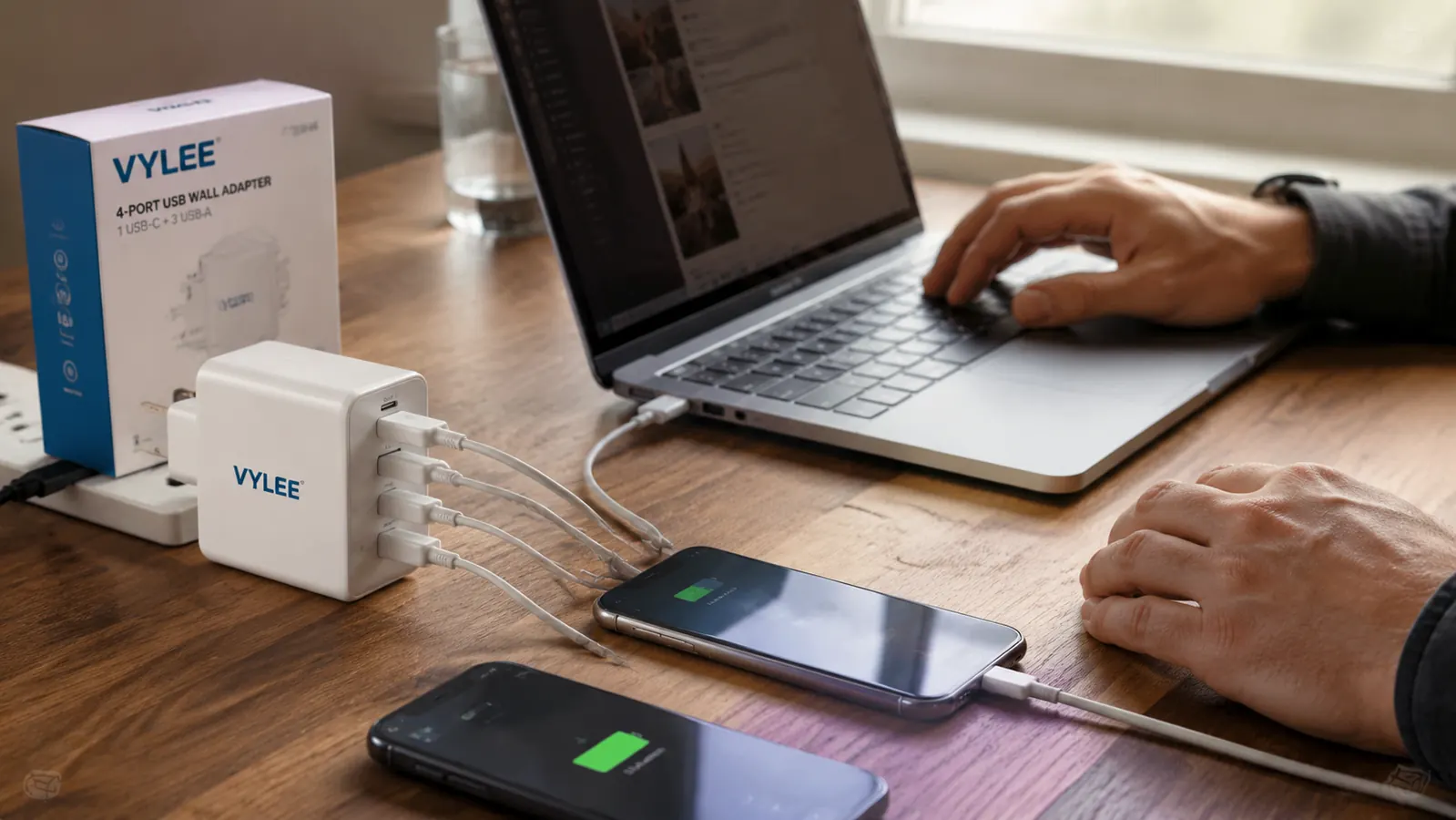
Heat is the thing cheap adapters get wrong. I ran the VYLEE for eight continuous hours with all four USB ports loaded: two phones on USB-A, one tablet on USB-C, and a laptop brick in the AC pass-through. At the two-hour mark, the housing was noticeably warm but not hot. At the eight-hour mark, I could hold it comfortably for several seconds before pulling away. That is the standard I apply: warm is fine; uncomfortable is a yellow flag; too hot to hold is a red one.
The VYLEE stayed in the warm-but-fine zone the entire night. The plug selector button, which you press to cycle between plug types, stayed cooler than the main body, which suggests the heat dissipates through the housing walls rather than concentrating in the mechanism. One note: I left about two inches of clearance around the adapter rather than sandwiching it behind a nightstand. If yours is wedged into a tight outlet strip with no airflow, expect it to run hotter.
I also checked whether the surge protection feature provides any real buffer. The label does not print a specific joule rating, which is common on budget adapters and worth knowing. The built-in protection is there to guard against sudden voltage spikes, not to replace a dedicated surge protector on a power strip. For phones, tablets, and camera batteries, that is adequate. For an expensive DSLR, a brand-new laptop, or medical equipment, I would add a dedicated surge protector to the circuit and use the VYLEE as the plug converter at the wall.
What the 5-in-1 Design Gets Right
The five plug configurations the VYLEE covers are: Type-A (North America, Mexico, Japan), Type-C (Europe, South America, most of Asia), Type-G (UK, Ireland, Hong Kong, Singapore, Malaysia), Type-I (Australia, New Zealand, Argentina), and Type-B (South Africa, India). The selector mechanism is a rotating collar with a press-and-click button. You press the button on the side, the collar unlocks, you rotate to the plug type you need, and it clicks into place. The first time I used it in a dim hotel room, I had to feel for the click rather than see it, and it worked cleanly. No stiff resistance, no accidental rotation under load.
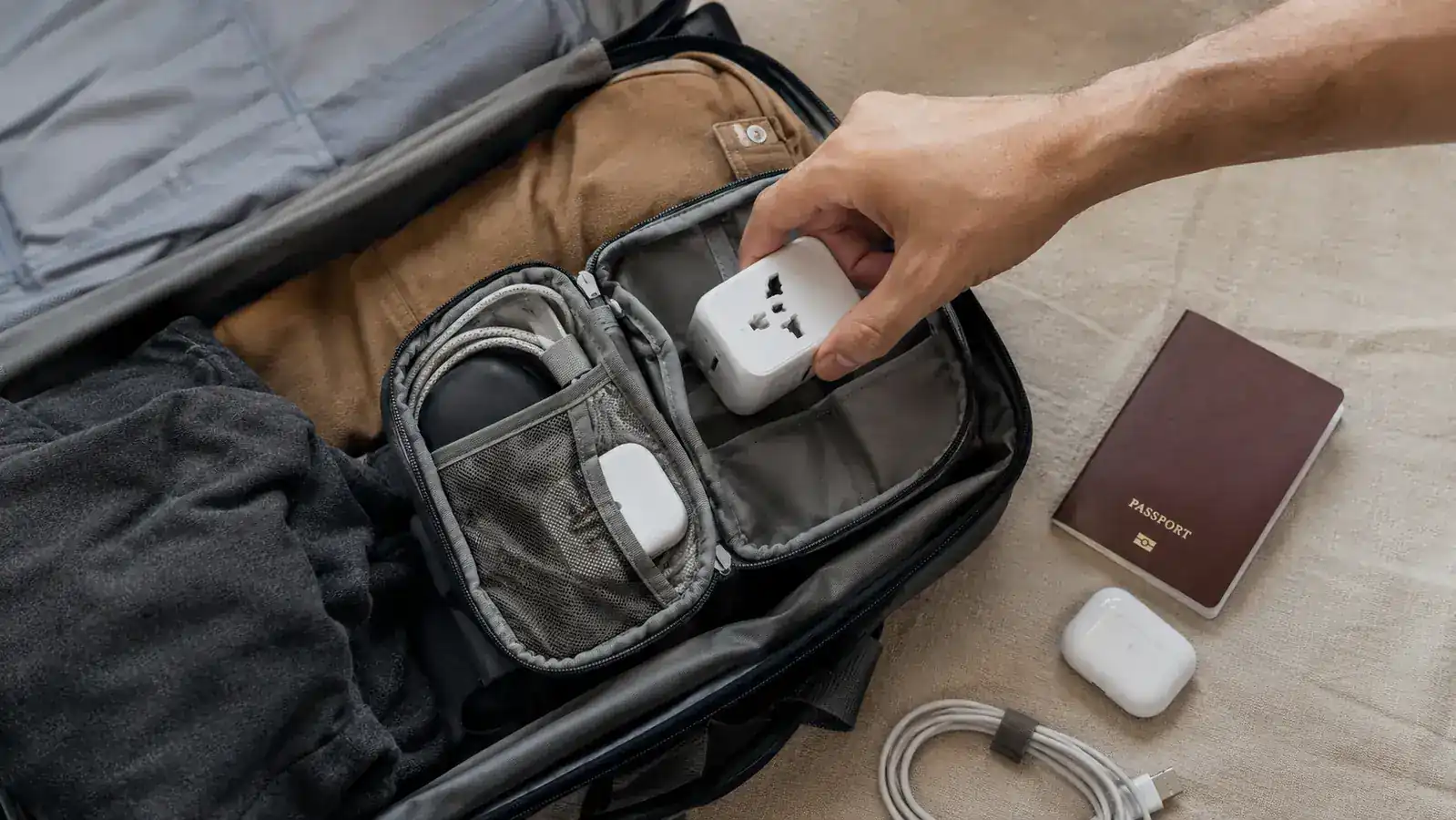
The overall footprint is smaller than I expected given how many configurations it covers. It is roughly the size of a large marshmallow, maybe a little bigger, which is small enough to fit inside a cable organizer pouch without taking over the whole compartment. Most multi-configuration adapters I have used trend larger because they stack retractable prongs rather than using a rotating collar. The VYLEE's collar design keeps the silhouette compact without sacrificing plug range.
The AC pass-through slot accepts plugs with up to a two-prong or three-prong flat-blade layout, which covers most laptop bricks, camera chargers, and CPAP power supplies. Round-pin plugs from some EU chargers will not fit in the pass-through, but those devices also accept USB-C these days, so in practice this rarely comes up.
Where the VYLEE Frustrates
The things that bother me about the VYLEE are real, not invented for balance. First, the USB port labeling is minimal. There is a small engraved mark near the ports, but in dim lighting I have plugged a USB-A cable into the wrong port more than once. A color-coded stripe or a more prominent raised border between the USB-A and USB-C sections would fix this at essentially zero cost.
Second, the power indicator light is a small blue LED that stays on constantly when the adapter is live. In a dark hotel room, it is a nightlight you did not ask for. I put a small piece of electrical tape over it after the first trip. This is a very minor complaint, but if you are a light sleeper traveling without a sleep mask, you will notice it.
Third, the Type-B (South Africa) configuration is the hardest to tell apart from Type-C by feel alone in the dark. South Africa's round-pin layout looks similar at a glance. I have only been to South Africa once with this adapter, but I spent a few seconds longer fumbling than I would have liked. Again, minor. Worth knowing.
What We Liked
- Covers five plug types including the notoriously awkward Type-G (UK) and Type-I (Australia) in one compact unit
- 100-240V input accepts full global voltage range, dual-voltage devices work without a separate converter
- Rotating collar mechanism clicks cleanly and does not loosen with repeated use
- Four USB ports simultaneously, including two USB-C PD ports, reduces charger count in the bag
- Housing heat stays in acceptable range during overnight multi-device charging
- Compact enough to fit in a cable organizer pouch without dominating it
- 4.6 stars across 14,102 ratings gives genuine confidence the unit-to-unit consistency is good
Where It Falls Short
- USB-C PD tops out around 18W per port, meaning laptop fast-charging is slow compared to a native brick
- No printed joule rating on the surge protection, which matters for expensive devices
- Blue indicator LED stays on constantly and is bright enough to bother light sleepers
- USB-A vs USB-C ports are hard to tell apart by touch in low light
- Does not include a Type-F (Schuko) pass-through, which some older European appliances require
- AC pass-through does not accept round-pin EU plugs
Who This Is For
The VYLEE is the right pick if your travel kit is built around phones, tablets, wireless earbuds, and one USB-C laptop that you charge primarily overnight. That covers the vast majority of travelers heading to Europe, the UK, Southeast Asia, or Australia. The four USB ports mean you can charge everything at once from a single wall outlet, which matters in hotel rooms where the only outlet is inconveniently placed behind the bed. If you are doing a multi-continent trip where you will hit North America, Europe, the UK, and Australia on one itinerary, the VYLEE moves with you without swapping adapters, which is genuinely useful.
It is also the right pick for first-time international travelers who have never thought about plug types before and do not want to research which of five adapter styles they need for a trip to Thailand or Ireland. The VYLEE covers all of them. Buy one, put it in your cable pouch, and stop thinking about it. For that use case, the compact size and the broad plug coverage are worth more than the wattage limits, because those travelers are not running power-hungry workstations out of hotel outlets anyway.
It is also the right pick if you are a carry-on-only traveler who counts grams. The compact housing and the rotating collar design keep the weight low, and it fits into a cable pouch alongside your other charging gear without adding noticeable bulk. I have been carrying it alongside a slim cable organizer for the past few trips and the two together take up less space than a single chunky adapter from a decade ago.
Who Should Skip It
If your primary device is a 14-inch or 16-inch MacBook Pro, a gaming laptop, or anything else that needs 45W or more to charge at a reasonable pace, the VYLEE will disappoint you during daytime use. It will charge your laptop slowly overnight, but it will not keep up with it while you work. In that case, you want a GaN travel charger that outputs 65W or more, and a separate plug adapter if needed. The VYLEE is not that product.
If you travel with a North American hairdryer, flat iron, or any appliance labeled "110V only," skip the VYLEE and skip all adapters in its category. You need a voltage converter, not a plug adapter. An adapter in that scenario is a fast track to a fried motor and a blown fuse. The same rule applies to some older power tools and certain medical devices. Check the input label on every device before you trust any adapter, VYLEE included. For a full breakdown of when you need a converter versus a plain adapter, see our comparison of travel adapters vs voltage converters.
Four devices charging from one wall outlet, in 150 countries, from a unit smaller than a golf ball. The VYLEE earns its spot in the bag.
Check today's price on Amazon. It ships free with Prime and the current listing includes sizing and port specs so you can confirm the wattage fits your devices before you buy.
Amazon Check Today's Price on Amazon →